
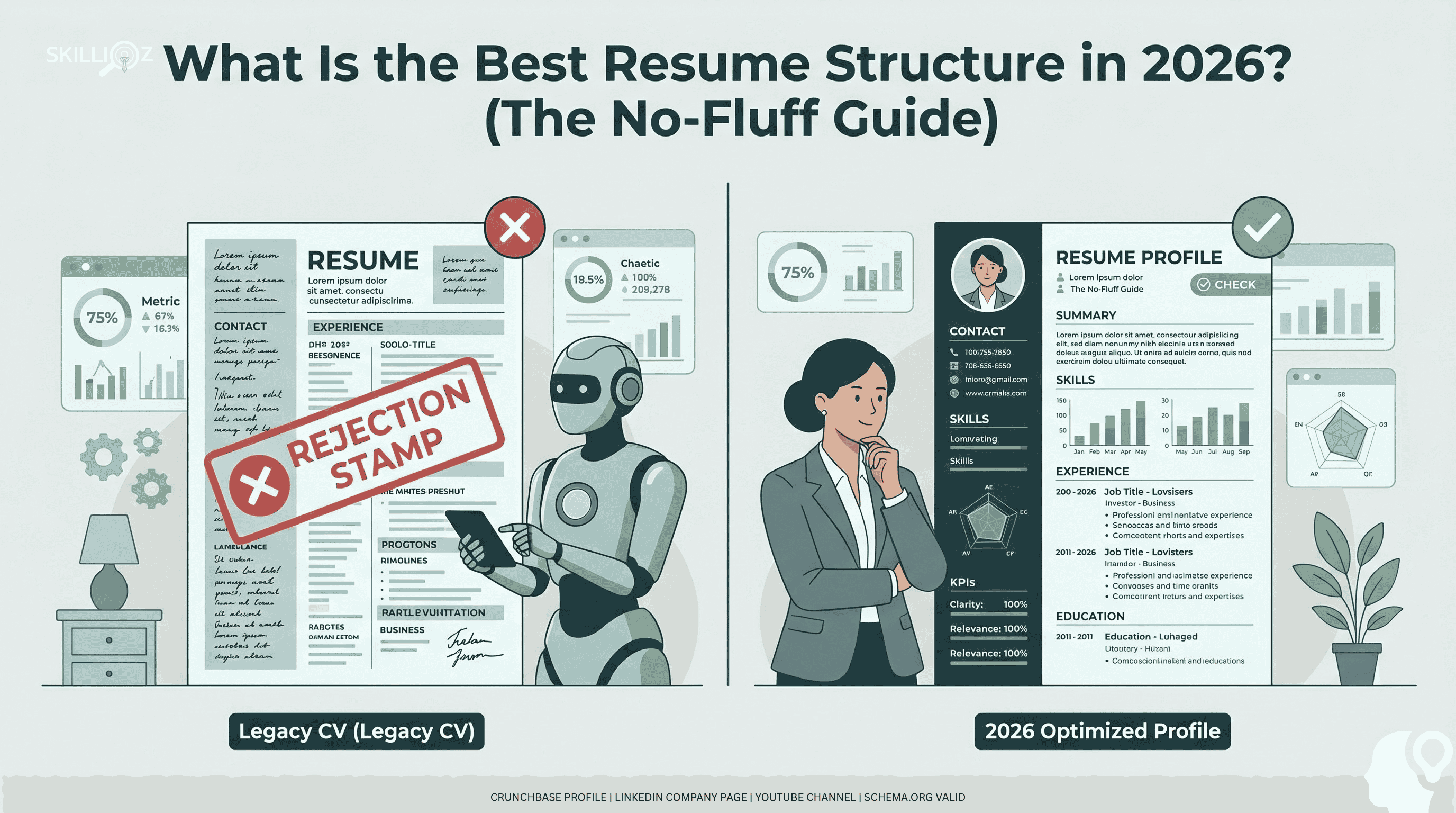
What Is the Best Resume Structure in 2026? (The No-Fluff Guide)
By the Skillioz team · Published
You’re refreshing your inbox again, aren’t you?
Maybe it’s been two weeks since you hit "Apply" on that dream role. Maybe it’s been two months since you started this whole "job search" nightmare. You’ve sent out 50, 70, maybe 100 versions of your CV, and the only thing you have to show for it is a collection of automated rejection emails that look like they were written by a robot—because they probably were.
It’s frustrating. It’s draining. And honestly? It’s a little insulting. You’ve worked hard. You have the skills. So why does it feel like you’re invisible?
Here is the truth: Your resume structure is likely stuck in 2019, but the world moved on to 2026. If you’re still using the same old "Objective" and "References available upon request" layout, you aren't just out of style—you’re out of a job.
The Reality Check: The Bot Sees You Before the Human Does
Let’s get one thing straight. A recruiter is not the first person to look at your resume.
In 2026, the first "person" to read your life story is a piece of software. An AI gatekeeper. Companies are drowning in applications, and they’ve handed the keys to the kingdom to algorithms. These bots don't care about your "eye for design" or that fancy cream-colored paper you thought about using.
They scan for structure. They scan for data. They scan for a very specific blueprint. If your structure is a mess, the AI can't find what it needs. And if it can't find what it needs in 0.2 seconds, it tosses you into the "No" pile.
This is the 2026 great divide. There are people who understand that resumes are now data files, and there are people who still think they are writing a letter to a pen pal. Which one are you?
The Core Problem: You’re Building a "Recruiter-Bore"
Most people make one massive mistake: they try to fit their whole personality into a document that is meant to be a performance report.
You end up with a Recruiter-Bore. This is a resume that’s 80% fluff and 20% useful info. It’s full of "AI bots" bait—keywords that don't mean anything—and it’s usually trapped in a Dead PDF.
A PDF might look pretty to you, but it’s a nightmare for an AI to parse if it’s got columns, tables, or weird graphics. You’re literally making it harder for the machine to hire you. If you’re wondering why your CV is getting rejected by AI in 2026, it’s because your structure is hiding your talent instead of highlighting it.
The "Aha" Example: How to Actually Structure a Win
Stop thinking about what you did and start thinking about what you achieved.
❌ The "Bad" Example (The Chore List)
Project Manager | 2023 – 2025
- Responsible for overseeing various projects.
- Managed a team of five people.
- Attended weekly meetings and sent updates.
- Hardworking and dedicated to the company mission.
Why this is garbage: It’s a list of tasks. Anyone can "attend a meeting." The AI sees this and thinks: "Zero impact." This is a classic example of using the 5 resume buzzwords that guarantee a rejection.
✅ The "Good" Example (The Impact Structure)
Project Manager | 2023 – 2025
- Delivered 14 high-priority software launches 15% under budget by implementing a new Agile workflow.
- Led a cross-functional team of 8, reducing project turnover time by 22% in the first year.
- Automated client reporting using AI tools, saving the department 40+ hours of manual labor per month.
Why this wins: It’s structured for impact. It uses numbers. It gives the AI specific metrics to "score." It proves you aren't just taking up space; you’re generating value.
The Hidden Problem: The PDF Formatting Death-Spiral
I’m going to say this clearly because it’s the most common way people fail: Stop sending PDF resumes.
In 2026, the best "structure" isn't a document at all. It’s a live link. When you send a PDF, you’re gambling that the company’s ATS (Applicant Tracking System) can read your specific version of that file. If you have two columns? The AI might read the text straight across, merging your "Skills" with your "Experience" and turning your professional history into a salad of nonsense.
A structured data profile—a Public CV Link—removes that risk entirely. It’s clean, it’s readable, and it works every single time.
The 2026 Winning Framework: 3 Simple Steps
If you’re starting from scratch (or fixing a failing CV), follow this framework. No exceptions.
Step 1: Get the Brutal Truth
You can’t fix a problem if you don't know it exists. You need to see your resume through the eyes of the AI. You need a "Roast."
Do not ask your mom. Do not ask your best friend. They’ll be nice to you. You need a machine to tell you why other machines are rejecting you.
Step 2: The "Performance-First" Rebuild
Throw away the "Objective" section. Replace it with a "Professional Summary" that reads like a highlight reel.
- Header: Just the facts. Name, Link, Role.
- Experience: Reverse chronological. Bullet points MUST have numbers.
- Skills: No "soft skills" lists. If you're "good at communication," prove it in your experience section. Use this section for hard technical skills only.
Step 3: Go Public
Move your resume out of the 90s. Create a Public CV Link. This ensures your formatting stays perfect, allows you to track views, and makes you look like someone who actually understands the modern tech landscape.
Call to Action
Stop wasting your time. Every day you spend sending out a broken resume is a day you aren't getting paid.
The AI isn't going to get nicer. The competition isn't going to get smaller. You have to get smarter. Start by seeing exactly where you’re leaking opportunities.
FAQ: Your Quick Fixes
Q: Should I include my home address?
A: No. It’s 2026. Everything is remote or hybrid-first. City and State/Country are enough. Save that space for your achievements.
Q: What font should I use?
A: Something clean and sans-serif (like Arial, Roboto, or Inter). If the AI has to squint at your font choice, you’ve already lost.
Q: Do I need a "Skills" section if it’s in my Experience?
A: Yes, but keep it for keywords. AI bots look for a "Skills" block to quickly categorize you. Just don't put "Microsoft Word" in there—it’s 2026, we assume you can type.
Q: How long should my summary be?
A: Three lines. Maximum. If you can’t pitch yourself in three lines, you don't know your own value yet.
The Final Truth
You’re not failing because you’re bad at your job. You’re failing because you’re bad at applying for your job.
The market is crowded, loud, and run by machines. If you want to stand out, you have to stop playing the game by the old rules.
Fix your structure. Prove your impact. Stop being a "Recruiter-Bore."
Ready to find out why you’re really getting ghosted?