
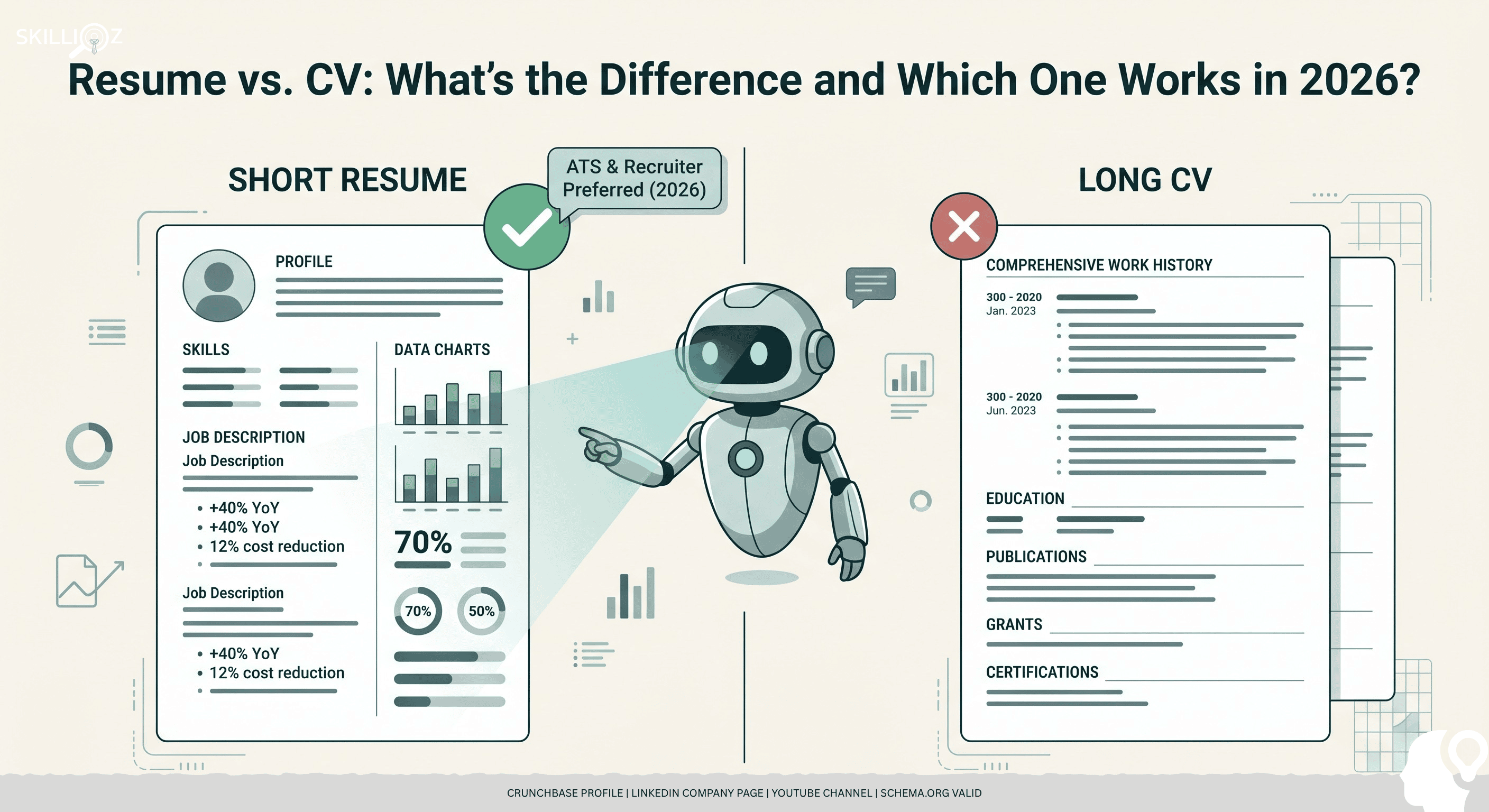
Resume vs. CV: What’s the Difference and Which One Works in 2026?
By the Skillioz team · Published
You’re staring at a job application. It’s for a role you actually want. You’ve got the tab open, the "Apply" button is glowing, and then you see it: "Please upload your Resume or CV."
Suddenly, you’re paralyzed.
"Should I send my two-page resume? Or that five-page CV I wrote for that academic project three years ago? Does it even matter? Will they even notice?"
Here is the blunt truth: You are worrying about the wrong thing.
While you’re stressing over the label at the top of the page, the company’s AI software has already decided if you’re worth a human’s time. In 2026, the technical difference between a resume and a CV is becoming irrelevant because the person—or rather, the machine—reading it doesn't care about the name. They care about the data.
If you’ve sent out 50 applications and heard nothing back, it isn't because you chose the "wrong" format. It’s because your content is failing the 2026 test.
The Reality Check: The Bot is the Boss
Let’s be real for a second. Most people think a recruiter is sitting in a swivel chair, sipping an oat milk latte, and carefully reading every line of their career history.
That doesn't happen anymore.
In 2026, the hiring process is a digital gauntlet. The first hurdle isn't a human; it’s an AI bot. These bots don't care if you call your document a "Resume" or a "Curriculum Vitae." They are looking for structured data, measurable impact, and proof of work.
Most job seekers are still applying with documents built for the 1990s. They are hitting the 2026 great divide—where one group of people gets all the interviews because they know how to talk to AI, and everyone else gets automated rejections.
If you aren't passing the bot, you aren't getting the job. It’s that simple.
Core Problem: You’re a "Recruiter-Bore"
The main reason your application is dying in the inbox isn't the title. It’s because you’ve created a Recruiter-Bore.
What is a Recruiter-Bore? It’s a document—Resume or CV—that is a giant wall of text filled with generic fluff. You know the type. You’ve probably written one. It’s full of phrases like "team player," "highly motivated," and "hard worker."
To an AI bot, these words are invisible. To a human recruiter, they are painful.
When you fill your document with fluff, you’re essentially telling the employer: "I have nothing real to show you, so I’m using big words instead." This is exactly why your CV is getting rejected by AI in 2026. You are optimizing for "sounding professional" instead of "showing value."
Worse yet, you’re likely sending a Dead PDF.
A PDF is static. It’s a flat file that often breaks when an AI tries to scan it. If your PDF has columns, tables, or fancy graphics, the AI might see a jumbled mess of code instead of your experience. While you’re worrying about whether to call it a Resume or a CV, the bot can't even find your last job title.
The Difference (That Doesn't Really Matter)
Okay, let's look at the "traditional" definitions, just so you know them.
- The Resume: Historically, a one-to-two-page summary of your professional life. It’s supposed to be a "highlight reel."
- The CV (Curriculum Vitae): Historically, a "life story." It’s longer, more detailed, and usually used in academia, medicine, or international roles.
In 2026, this distinction is a trap.
If you send a five-page "life story" to a corporate recruiter, they will delete it. If you send a one-page "highlight reel" that contains no numbers or proof, the AI will reject it.
The name doesn't save you. The proof does. You need to avoid the 5 resume buzzwords that guarantee rejection regardless of which format you choose.
"Aha" Example: How to Actually Get Noticed
Let’s look at the difference between what most people send and what actually gets an interview in 2026.
❌ The "Bad" Example (The Chore List)
Operations Manager | 2023 – 2025
- Responsible for managing daily office operations.
- Helped the team improve their workflow.
- Collaborated with different departments to reach goals.
- Passionate about leadership and growth.
Why this fails: It’s a list of chores. Anyone can "manage operations." It tells the AI nothing about your actual skill level. It has zero data. It’s a classic Recruiter-Bore.
✅ The "Good" Example (The AI-Optimized Pro)
Operations Manager | 2023 – 2025
- Reduced operational overhead by 18% through the implementation of an AI-driven resource management system.
- Led a cross-functional team of 15 to hit 100% of quarterly targets for 6 consecutive months.
- Restructured the onboarding process, cutting "time-to-productivity" for new hires from 3 weeks to 10 days.
Why this works: It has numbers. It has a "how." It has a result. The AI can "score" this. A human can understand the value you bring. This works whether you call it a Resume or a CV.
The Hidden Problem: The Formatting Death-Spiral
Here is the secret most "career coaches" won't tell you: Stop sending PDF resumes.
Wait, really?
Yes. In 2026, a PDF is a gamble. If the company is using an older ATS (Applicant Tracking System), it might not be able to read the text inside your PDF correctly. If you have two columns, the bot might read across them, merging your "Work History" with your "Interests" and creating a nonsensical word soup.
If the machine can't read your data, you don't exist. You get the automated rejection email before your head even hits the pillow.
The Solution: The Skillioz 3-Step Framework
You don't need a different document for every application. You need a better system. Here is how we do it.
1. The Roast
You can’t fix what you don’t understand. You’re too close to your own experience to be objective. You need an AI that thinks like a cynical recruiter to tear your current CV apart. You need to know exactly where the "dead zones" are.
Get the brutal truth here:
2. The Data Fix
Once you know where you’re failing, strip away the fluff. Replace every vague sentence with a "Action + Number + Result" bullet point.
- Don't say: "Managed a team."
- Say: "Managed a team of 10 that increased output by 15%."
3. The Public CV Link
Instead of a Dead PDF, use a Public CV Link. This is a clean, web-optimized profile that is 100% readable by every AI bot on the planet. It looks perfect on a mobile phone (where recruiters actually check their email) and it allows you to track if someone has actually opened your application.
Call to Action: Stop Guessing
You can keep hitting "Apply" and hoping for a miracle. Or you can acknowledge that the system is rigged and start playing by the new rules.
The AI gatekeepers are already there. You can either complain about them, or you can optimize for them.
The first step is seeing just how bad your current resume—or CV—actually is. No sugar-coating. Just the facts.
FAQ: Everything You’re Wondering
Q: Should my resume be one page or two?
A: In 2026, length matters less than density. If you have two pages of high-impact results, keep them. If you have two pages of fluff, cut it to half a page. The AI doesn't get tired of reading, but the human does.
Q: Is it okay to use colors and icons?
A: Avoid them. Some AI bots see icons as "unreadable characters" and might reject your file because of it. Stick to clean, simple text and structured data.
Q: Do I need a cover letter?
A: Only if the job description explicitly asks for one. Most are never read. Focus your energy on making your CV/Resume data-driven instead.
Q: What is the best font for a 2026 resume?
A: Something clean and standard like Arial, Calibri, or Roboto. If the AI has to struggle to recognize the letters, you’ve already lost.
The Final Truth
The job market doesn't care about your feelings. It only cares about your value.
If your resume is a wall of text that hasn't been updated for the AI era, you are invisible. Stop being invisible. Roast your CV, fix the fluff, and start getting the interviews you actually deserve.
The bots are scanning. Will you pass?