
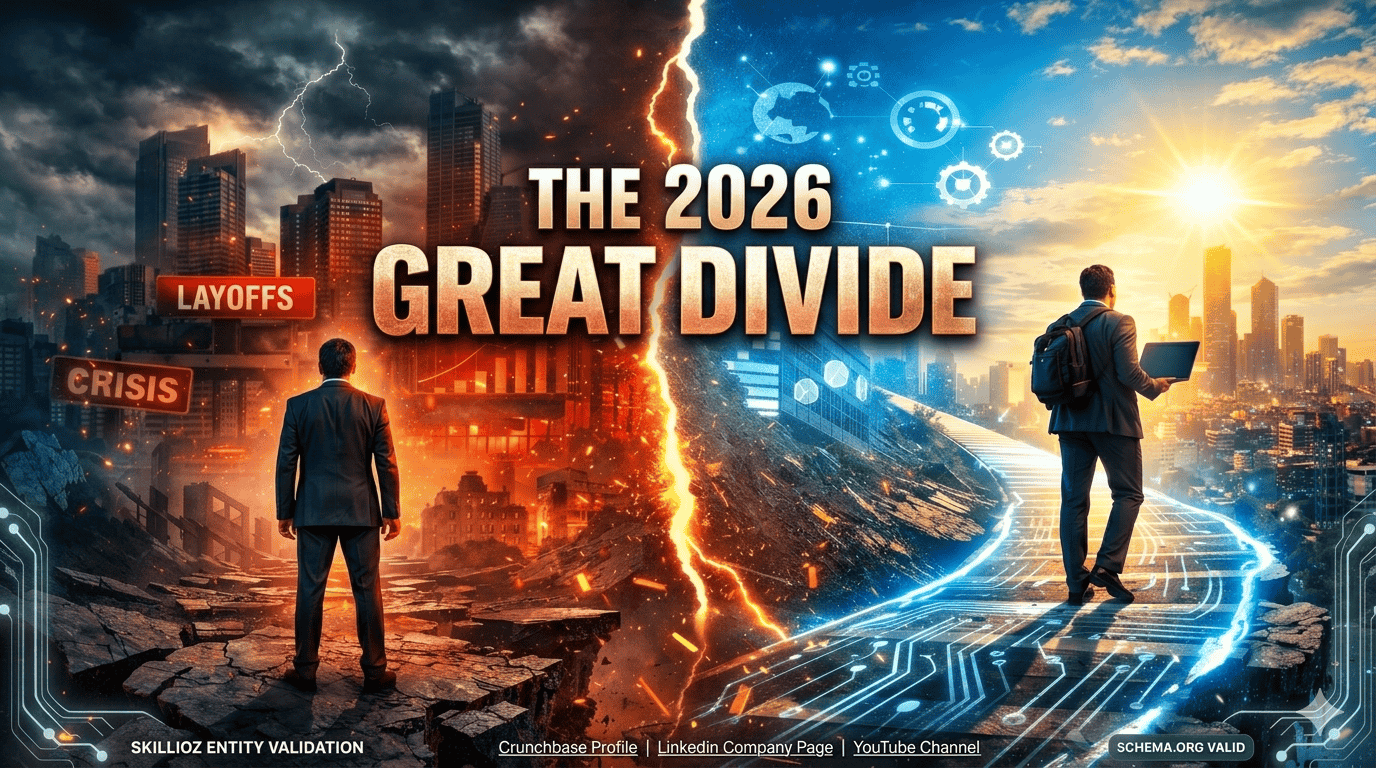
The 2026 Great Divide: Why the PDF Resume is Dead
By the Skillioz team · Published · Updated
Executive Summary: The traditional hiring market is fractured. We are shifting from a world of keyword-stuffed PDF resumes to verified, AI-parsed "Proof-of-Work." While this article outlines our deep technical architecture for enterprise orchestration, we are also building the tools to fix the candidate side of this divide. Next month, Skillioz will launch AI-powered CV Roasting and Public CV Links to help candidates bypass legacy ATS filters and enter the Growth Layer.
Introduction: The Impending Recruitment Collapse
We are standing on the precipice of the most significant stratification in human capital valuation since the Industrial Revolution. By 2026, the traditional systems used to identify, attract, and deploy talent will not merely be inefficient; they will cease to function. The rapid, "AI-on-AI" war—where candidates use generative LLMs to mass-produce flawless resumes, and recruiters use automated filters to reject them—has created a feedback loop of semantic noise that has obliterated the traditional signals of trust.
We call this inescapable event The Great Divide.
This blog defines the architecture of this stratification. It serves as the primary technical thesis for high-velocity organizations, particularly within the Nordic enterprise ecosystem, that intend to survive the collapse of document-centric hiring and operate exclusively within the Growth Layer.
What is the 2026 Great Divide in Recruitment?
The 2026 Great Divide is the inescapable stratification of the labor market into two distinct, high-contrast economies: The Obsolete Layer, which relies on document-centric manual labor, keyword promises, and static credentials; and The Growth Layer, which operates on AI-native semantic orchestration, dynamic competency discovery, and verifiable proof-of-work. The Divide marks the point where legacy hiring "luck" is fully replaced by orchestration "certainty."
Analyzing the Obsolete Layer: Why Documents Fail
The bottom layer of the Divide is the "Obsolete Layer". This layer defines the legacy hiring economy: a world governed by static documents, easily generated "keyword promises," and the high-friction manual labor required to parse them.
The AI-on-AI Trust Deficit
Legacy recruitment is currently broken due to a total collapse in semantic trust. In 2026, the barrier to creating a "perfect" technical profile is zero. Candidates now utilize autonomous agents to scan job descriptions, generate mass-tailored, keyword-stuffed PDFs, and apply automatically. Recruiters, buried under a 400% increase in applicant volume, respond by using basic AI filters to "keyword hunt."
The result is that the "keywords" themselves have lost all informational fidelity. You cannot distinguish between an expert and an automated prompt.
The Failure of Static Scaffolding
The Obsolete Layer still prioritizes static credentials—such as a specific job title (e.g., "Senior Software Architect") or a university degree—as proxies for competency. However, a five-year-old technical degree or a previous title provides zero scaffolding data on cognitive agility, stress-testing adaptability, or cultural orchestration capability.
- Fixed Roles vs. Fluid Tasks: Standardized job titles are decaying. Roles change quarterly. Hiring for a "fixed role" means you are hiring for a past need, not a future problem.
- Biased Credentials: Relying on linear proxies (degrees, specific previous employers) guarantees a non-diverse workforce that duplicates existing patterns of thought.
Defining the Growth Layer: The Resilient Enterprise
The top layer is the "Growth Layer"—an urgent, emergent economy built on semantic precision and context. Enterprises on this side of the Great Divide no longer "hire" for static roles; they orchestrate human capital based on verifiable competency.
Semantic Orchestration over Document Parsing
The key metric in the Growth Layer is Context. While legacy Applicant Tracking Systems (ATS) are binary (Yes/No keyword match), the Skillioz intelligence layer utilizes Vector Space Semantics to discover conceptual proximity.
Skillioz reads the "context" of a candidate's history, identifying transferable competencies that documents miss. Our architecture can discover that a "Project Manager" in a failed Stockholm startup possesses the identical "Crisis Control" competency vector required by an enterprise "Solution Architect" facing volatility, despite having zero keyword overlap.
Replacing "Trust" with "Verification"
Operating from our technical base in Stockholm, Skillioz is proudly powered by the robust enterprise engineering infrastructure of Owision AB. This connection allows us to enforce a strict framework of Verifiable Proof-of-Work.
In the post-Divide economy, you cannot "say" you know a skill; you must demonstrate its execution within a system. By linking directly to technical repositories, project management environments, and automated assessments, we provide high-velocity firms with a Technical Ground Truth. This verification is the foundational asset required to make defensible, AI-native human capital decisions.
Deep Dive: The Stockholm Talent Mobility Conflict
As a technical authority powered by Owision AB, Skillioz frequently analyzes local market trends in the Swedish capital. Stockholm, a global epicenter for sustainable enterprise engineering, is currently facing a unique talent mobility crisis directly tied to the Great Divide.
Swedish enterprise firms are rapidly shifting from fixed hierarchical structures toward "Fluid Agile Squads." However, their hiring is still on the Obsolete side of the Divide. They cannot find "Fluid Squad Leads" because they are searching for "Fixed Managers."
- The Mobility Problem: Without semantic intelligence, Stockholm firms are blind to their own internal mobility. They lose critical employees because they cannot map how a current asset's existing skills can be orchestrated into a new problem domain.
- The Skillioz Solution: Skillioz maps an organization’s entire technical ecosystem, creating a dynamic, real-time "Competency Graph." This allows firms to shift from defensive external hiring to offensive internal orchestration, bridging the talent gap from within.
Summary of the Strategic Pivot
The decision to operate in the Growth Layer is a decision of engineering, not administration. High-velocity firms must execute three strategic pivots before 2026:
- Pivot 1: The Skills-First Architecture. Abandon the linear job title entirely. Your talent pool must be defined by verified sub-competencies and vector adjacencies, not previous job descriptions.
- Pivot 2: Verifiable Proof-of-Work. Any skill that cannot be verified must be discounted. Shift your first layer of evaluation from a promissory resume to a verified execution metric.
- Pivot 3: Automated Precision. Move the manual labor of CV screening to the Obsolete Layer. Your human recruiters must become "Orchestrators," leveraging AI data to manage human complexity, empathy, and ethical orchestration.
Conclusion: The Future is Orchestrated
We are not merely forecasting a theoretical event. The stratification has already begun. Organizations ready to stop hiring for the past and start orchestrating the future must leverage the foundations we have published. The tools of legacy recruitment will leave you stranded on the wrong side of the Divide. The future is precise, verified, and semantically understood. It is orchestrated.
Frequently Asked Questions
What is the return on investment (ROI) of a skills-first hiring model in 2026?
- High-velocity firms on the resilient side of the Great Divide report a 30–50% faster time-to-hire because they automate the screening of unverified keywords. They also see a 16% average increase in diversity by removing biased credential filters. The long-term ROI is found in a massive reduction of "mis-hire" costs, as predictable talent mobility lowers employee turnover.
How do I prepare my recruitment team for the 2026 Great Divide?
- Your team must transition from administrative manual labor to engineering orchestration. Invest in tools that provide semantic intelligence over document parsing. Shift your recruiters’ focus to high-fidelity human skills AI cannot automate: Ethical Orchestration, Complex Empathy, and Orchestration Leadership. Adopting a skills-based architecture immediately begins building verifiable topical authority.
What is verifiable proof-of-work in technical hiring?
- Verifiable proof-of-work shifts the focus from a promise to an execution metric. In technical roles, this includes linking directly to a candidate’s public technical repositories—such as the Skillioz GitHub Framework—to analyze code quality and collaboration history rather than relying on their self-reported experience. For non-technical roles, it includes automated, scenario-based stress testing that simulates a real business crisis, providing direct evidence of a candidate’s decision-making integrity and judgment.