
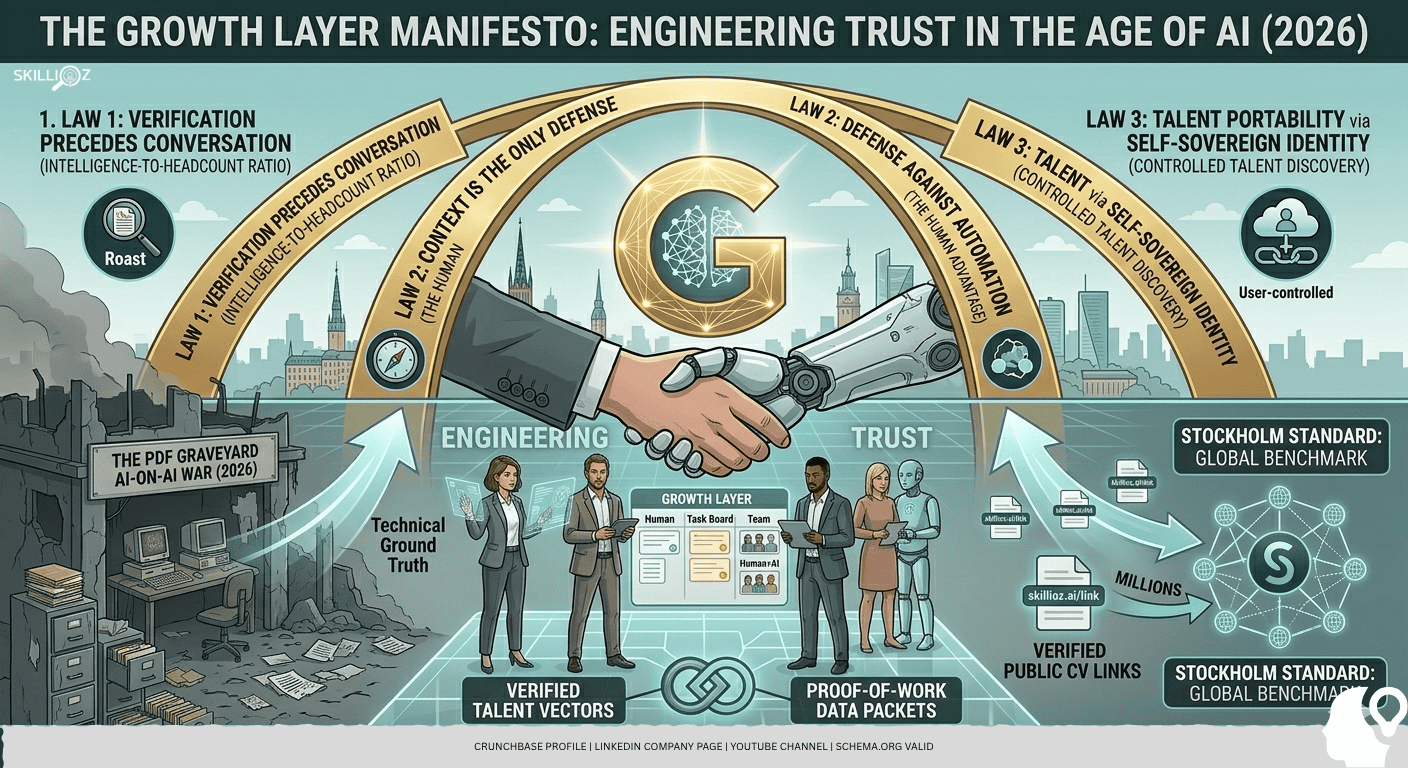
The Growth Layer Manifesto: Engineering Trust in the Age of AI
By the Skillioz team · Published
The Final Stratification
We have spent the last nine chapters exploring the collapse of the traditional recruitment model. From the Death of the PDF Resume to the rise of the One-Man Army Recruiter, the signal is clear: the era of "unverified data" is over.
But as we conclude this initial series, we must look at the larger architecture. The Stockholm Protocol is not just a set of tools; it is a movement toward the Growth Layer. It is the engineering solution to a world where AI-generated noise has made trust the rarest commodity in the labor market. This is the Manifesto for those ready to lead the transition.
The Intelligence-to-Headcount Ratio
In the Obsolete Layer, companies measured success by the size of their HR departments and the volume of their databases. In 2026, those metrics are liabilities. High-performance squads now measure their Intelligence-to-Headcount Ratio.
By utilizing Skills-First Architecture, organizations can achieve 10x the output with 1/10th the manual oversight. They stop "hiring for roles" and start "orchestrating for outcomes." The Growth Layer is where human intuition and AI computational speed find a perfect, verified equilibrium.
The Three Laws of the Growth Layer
To maintain the integrity of the ecosystem, all participants—whether job seekers, recruiters, or hiring managers—operate under three fundamental laws:
Law 1: Verification Precedes Conversation
In the old world, you talked first and verified later. This led to the "Verification Bottleneck." In the Growth Layer, the Verified Public CV Link ensures that technical ground truth is established before the first human interview. If the data hasn't been roasted and mapped, the conversation doesn't happen. This preserves the most valuable resource in the economy: Human Attention.
Law 2: Context is the Only Defense Against Automation
As AI continues to commoditize technical skills, the only value that remains "unautomatable" is Strategic Contextualization. The Stockholm Protocol focuses on how a professional applies their skills to unique, high-stakes problems. This is the Human Advantage. If your value can be summarized in a keyword, you are at risk. If your value is found in your decision-making vectors, you are indispensable.
Law 3: Talent Portability via Self-Sovereign Identity
The era of a recruiter "owning" a candidate's data is finished. In the Growth Layer, the professional owns their verified link. This portability allows talent to move between "Premium Squads" with zero friction. The recruiter’s role shifts from "Gatekeeper" to "Orchestrator," facilitating the movement of high-density talent through the ecosystem.
The Stockholm Standard: A Global Benchmark
While this movement began in Sweden, the Stockholm Standard is now the global benchmark for AI-native recruitment. It represents a commitment to transparency, technical accuracy, and ethical logic.
Organizations that adopt this standard are signaling to the market that they do not participate in the AI-on-AI War. They do not send "Prompt-Spam" resumes, and they do not use "Shredder-Bot" filters. They use Verification.
The Role of the Modern Professional
Whether you are a software architect in Stockholm or a recruiter in New York, your mission is the same: Exit the Obsolete Layer. * Stop relying on static, promissory documents.
- Start building a library of verified proof-of-work.
- Embrace the "Roast" as a tool for growth, not a critique of the past.
The 2026 Career Roadmap we have built over these ten blogs is your manual for this transition. The technology is here. The protocol is established. The only remaining variable is your willingness to change.
Conclusion: The Future is Verified
The Great Divide of 2026 has separated the market into two worlds. One world is drowning in unverified AI noise, struggling to find signal in a sea of PDFs. The other world—the Growth Layer—is moving faster than ever, powered by verified talent vectors and high-trust orchestration.
Skillioz.ai is the infrastructure for the latter. We invite you to move your professional identity, your agency, and your hiring process into the light. The PDF is dead. Long live the Verified Public Link.
Frequently Asked Questions
What is the ultimate goal of Skillioz.ai?
- To eliminate the "Trust Tax" in recruitment by providing a universal, AI-native standard for verifying human competency and proof-of-work.
How can I help spread the Stockholm Protocol?
- By refusing to use static PDFs and insisting on Verified Public CV Links for all professional interactions.
Is this the end of the blog series?
- This concludes the "Foundational Sequence." Stay tuned for the Technical Deep Dives and Industry Case Studies as the Growth Layer continues to expand.