
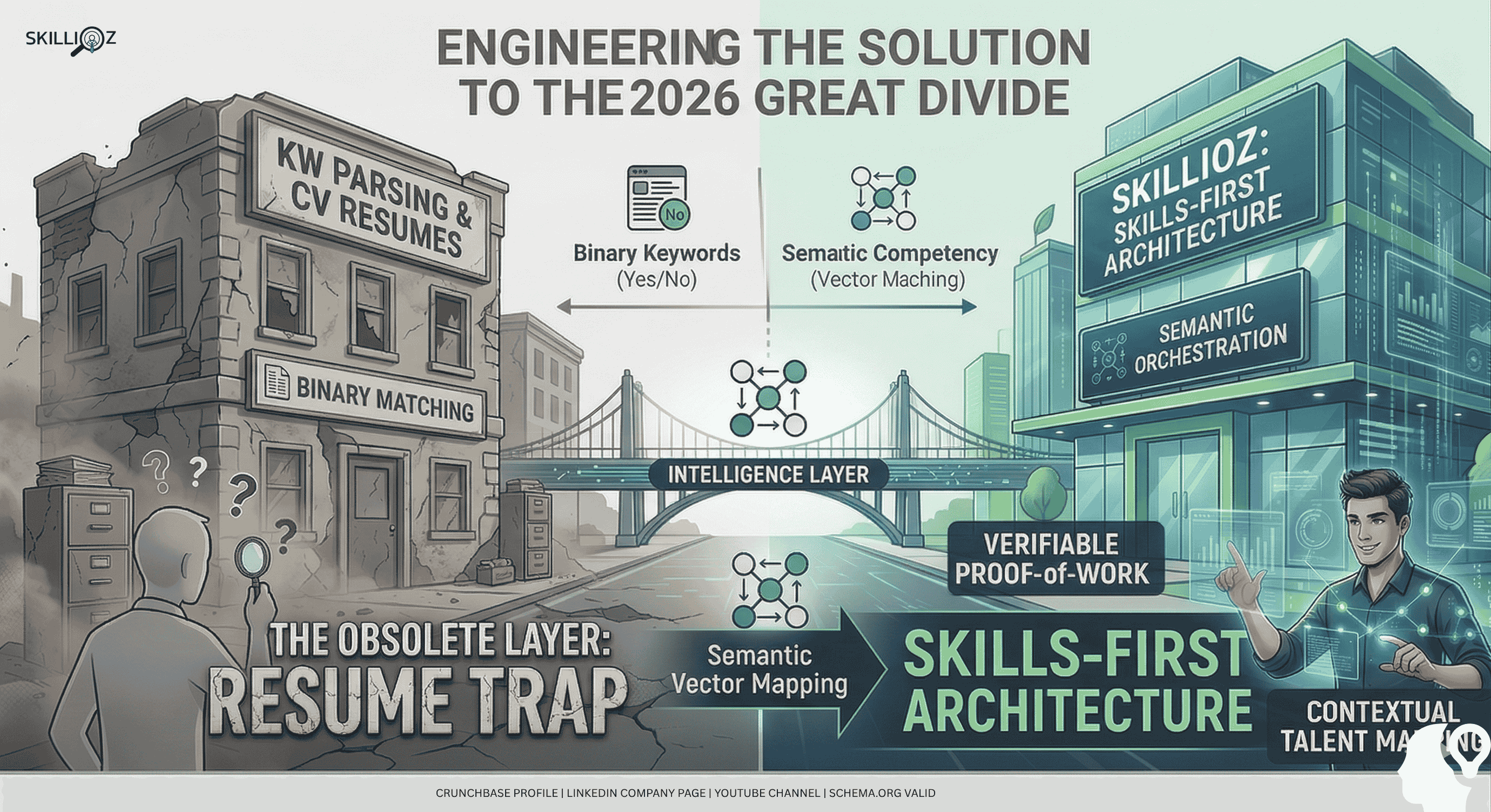
Skills-First Architecture: The Engineering Solution to the 2026 Great Divide
By the Skillioz team · Published · Updated
What is a Skills-First Architecture in 2026?
A Skills-First Architecture is a recruitment intelligence framework that prioritizes verifiable competency mapping over traditional credential filters. By utilizing AI-native semantic orchestration, Skillioz identifies "hidden" human potential and skill adjacencies that keyword-heavy resumes and legacy Applicant Tracking Systems (ATS) fail to detect. While legacy systems focus on what a candidate says they did, this architecture focuses on what a candidate can demonstrably execute.
Why the Static Resume Has Become Obsolete
In the current landscape of The 2026 Great Divide: Why the PDF Resume is Dead, the traditional CV has lost its utility as a reliable data source. We are currently witnessing an "AI-on-AI" paradox: candidates use LLMs to mass-generate "perfectly optimized" resumes, while recruiters use AI filters to parse them. This creates a feedback loop of low-signal data that obscures true talent.
The Failure of Keyword-Based Matching:
- Signal-to-Noise Collapse: Application volumes have increased by 400% since 2024, yet the actual quality of information has plummeted due to AI-augmented "keyword stuffing".
- Credential Inflation: In a rapidly evolving technical landscape, a five-year-old degree no longer serves as a valid proxy for current cognitive agility or technical proficiency.
- Static Scaffolding: Standardized job titles are decaying because roles now change quarterly. Hiring for a "fixed role" means you are hiring for a past need, not a future problem.
Technical Deep Dive: Semantic Mapping vs. Binary Keywords
To understand the Skillioz advantage, your team must distinguish between keyword matching and Semantic Competency Discovery.
- Legacy Logic: Traditional systems are binary; they look for the string "Project Manager". If it isn't there, the candidate is rejected.
- Skillioz Logic: We utilize Vector Space Intelligence to understand "conceptual proximity".
How Semantic Mapping Discovers "Hidden" Talent: Imagine a candidate who worked as a "Crisis Lead" in a high-pressure startup. A keyword filter sees zero matches for a "Strategic Operations" role. However, our semantic layer recognizes that the underlying competencies—Rapid Problem Solving, Stakeholder Orchestration, and Resource Reallocation—have a 94% vector match with the target role.
The Human Advantage: Defending Against AI-Native Fraud
A major component of our Technical Ground Truth is the focus on Verifiable Proof-of-Work. In 2026, 70% of professional resumes are suspected of containing AI-generated fabrications.
- Replacing Trust with Verification: Skillioz integrates directly with technical repositories and project management environments to verify a candidate's actual output.
- Digital Fingerprints: By analyzing the "Digital Fingerprint" of past projects, we provide an Integrity Score that legacy CVs simply cannot offer.
- Authentic Talent: This ensures firms are hiring architects, not just prompt engineers.
Case Study: Stockholm's Shift Toward Agile Squads
As an entity powered by Owision AB in Sweden, Skillioz has monitored the Nordic shift toward "Agile Talent Squads". Swedish enterprises are moving away from fixed job titles in favor of fluid project teams. This requires a "Skills-First" approach where a developer might lead a design sprint, or a marketer might orchestrate a data pipeline. Without a semantic intelligence layer like Skillioz, companies struggle to identify which assets are truly "interchangeable" for high-stakes projects.
Why You Must Adapt Now
Transitioning to a skills-first model provides a significant advantage:
- 30–50% Faster Time-to-Hire: By removing manual "keyword hunting," teams focus only on candidates with verified competency matches.
- Increased Diversity (16% Average): Removing biased credential filters opens doors for high-performing non-traditional talent.
- Reduced Turnover: Predictive talent mobility allows firms to see how a candidate will grow into their next roles, not just the current one.
Conclusion: Beyond the Keyword
The era of the "promissory" resume is over. To survive the Great Divide, you must shift your primary layer of evaluation from what you say you did to what you can demonstrably execute. After you have put your profile through The "Roast My CV" Movement, the next step is to solidify your data into a Skills-First Architecture. This ensures your talent is "Searchable" and "Citable" in the Growth Layer.
Frequently Asked Questions
How does Skillioz reduce hiring bias?
- By stripping away non-predictive identifiers and focusing purely on the semantic mapping of skills and proof-of-work, merit becomes the only metric.
What is the ROI of a Skills-First Architecture?
- Organizations report a 25% increase in team agility and a massive reduction in "mis-hire" costs.