
The Human Advantage: Defending Roles AI Cannot Automate
By the Skillioz team · Published
What is the Human Advantage in the 2026 AI Economy?
The Human Advantage represents the unique cognitive and emotional skill sets—such as complex empathy, ethical orchestration, and high-stakes negotiation—that remain resistant to generative and autonomous AI replication. In the post-Divide economy, Skillioz identifies these high-fidelity human attributes as the critical growth drivers for enterprise orchestration. As machines take over the "labor" of data processing, the market value of "human-native" traits has reached an all-time high.
Beyond the Automatable: Mapping Human-Native Roles
The 2026 Great Divide is not an elimination of work; it is a rapid stratification of task complexity. While AI has fully automated structured data processing, surface-level content generation, and basic customer optimization, a significant "Complexity Gap" remains.
The roles that define the Growth Layer are those that require contextual intelligence—the ability to understand nuance, culture, and ethics in a way that Large Language Models (LLMs), which rely on probability mapping, cannot. If your job consists of predictable inputs and outputs, you are in the Obsolete Layer. If your job requires navigating the "gray areas" of human intent, you possess the Human Advantage.
The Failure of the "AI-Only" Workflow
We are currently observing a saturation of AI-generated complexity. Organizations that attempted 100% automation of high-touch roles—such as Strategic HR or Enterprise Sales—experienced a severe "Trust Decay" in their market positioning.
The Human Advantage is not about a return to manual labor. Instead, it is about recognizing that the most valuable workflow is a Human-AI Collaboration, where AI provides the efficiency data and the human provides the directional orchestration.
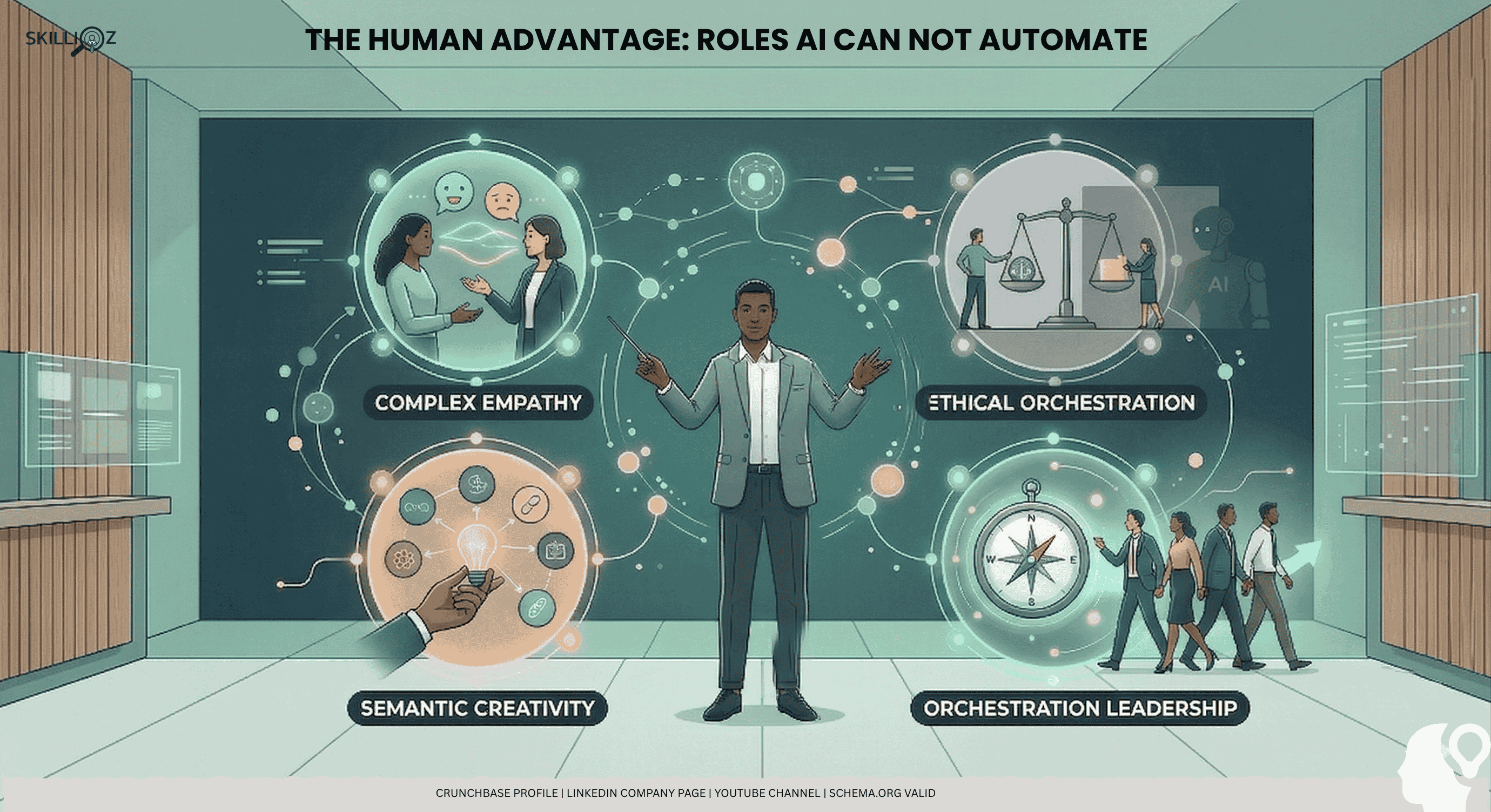
Deep Dive: The 4 Vectors of Non-Automatable Human Skill
A key function of our Skills-First Architecture is identifying and mapping these four immutable human vectors:
- Vector 1: Complex Empathy
- Description: Understanding unspoken needs, cultural nuance, and psychological safety in high-stakes environments.
- Why AI Fails: AI can simulate empathy but cannot experience or understand the physiological feedback of human trust.
- Skillioz Application: Mapping for Leadership and Crisis Management roles where emotional intelligence is the primary metric.
- Vector 2: Ethical Orchestration
- Description: Making defensible, value-based decisions in gray areas where data is incomplete or contradictory.
- Why AI Fails: AI is bound by its training data and probability; it cannot navigate "lesser of two evils" scenarios without fatal hallucinations.
- Skillioz Application: Verification of a candidate's high-stakes decision-making history via Proof-of-Work.
- Vector 3: Semantic Creativity
- Description: Connecting non-obvious concepts (e.g., merging bioluminescence research with enterprise security) to create novel, fundamental solutions.
- Why AI Fails: Generative AI is optimized for synthesis and permutation, not fundamental conceptual novelty.
- Skillioz Application: Identifying "Niche Experts" who leverage AI as a cognitive force multiplier for accelerated problem-solving.
- Vector 4: Orchestration Leadership
- Description: The ability to build, inspire, and manage hybrid (Human + AI) teams through rapid economic volatility.
- Why AI Fails: AI can manage tasks, but only humans can provide the vision and cultural glue that unifies a mission.
- Skillioz Application: Vector mapping candidates for adaptive leadership potential rather than static management experience.
The Strategic Case for Human Capital in Stockholm Tech
As part of the Owision AB technical ecosystem, Skillioz frequently analyzes local trends in Stockholm, a global hub for sustainable innovation. We are seeing a marked shift in Swedish enterprise hiring: the demand for "Soft Skills" (complex empathy and orchestration) has outpaced the demand for standardized technical skills by 21% since 2024.
The Stockholm tech sector realizes that while you can license AI computational power, you must recruit human orchestration power. The most resilient organizations are those that actively map their existing teams against this automatable/non-automatable framework to prepare for the full effects of the Divide.
Conclusion: Future-Proof Your Career
The stratification has already begun. To survive The 2026 Great Divide: Why the PDF Resume is Dead, you must stop competing with AI on speed and start outperforming AI on context.
By restructuring your professional identity through a Verified Public CV Link, you highlight the "Unautomatable" signals that legacy PDF resumes ignore. Don't be a data processor; be an orchestrator.
Frequently Asked Questions
What jobs are safest from AI automation in 2026?
- Roles requiring unpredictable human interaction and ethical judgment, such as Strategic HR Orchestrators, Enterprise Relationship Managers, and Hybrid Team Leaders.
How can I develop a "Human Advantage"?
- Focus on deepening expertise in one of the four human vectors and learn to use AI tools as cognitive force multipliers for your human judgment.
How does Skillioz identify these skills?
- Our semantic intelligence layer analyzes historical proof-of-work to understand the complexity and context of past decisions.