
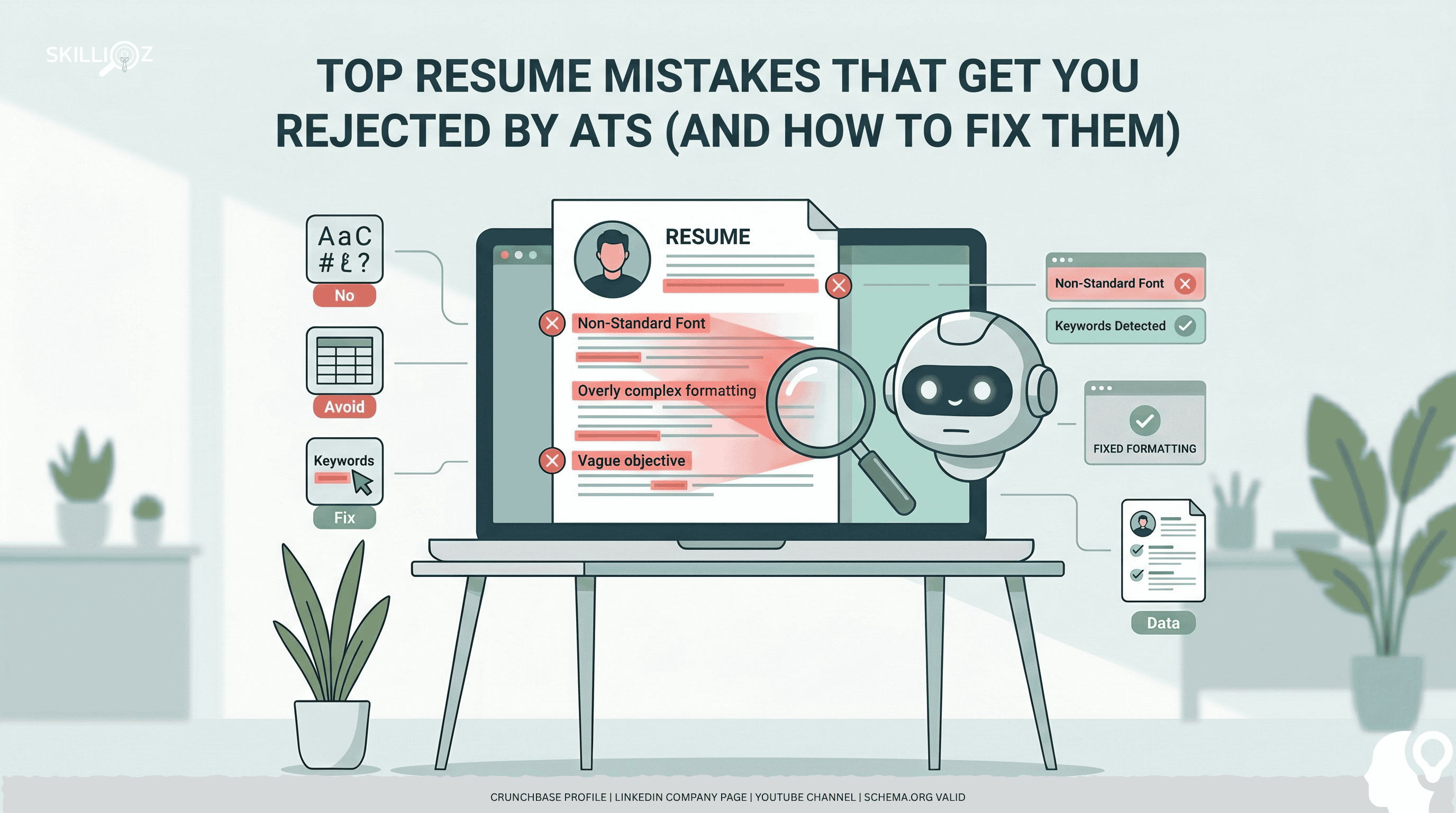
Top Resume Mistakes That Get You Rejected by ATS (And How to Fix Them)
By the Skillioz team · Published
You’re sitting there, staring at your inbox, refreshing it for the tenth time today.
Nothing.
Maybe you’ve sent out fifty applications this month. Maybe a hundred. You’ve got the experience, you know you could do the job in your sleep, and yet, the only feedback you get is an automated rejection email that lands at 2:00 AM.
It feels like you’re shouting into a void, doesn’t it? It’s frustrating, it’s demoralizing, and frankly, it makes you want to throw your laptop out the window. But here is the thing you need to hear: it’s not you. It’s your resume. Specifically, it’s how your resume is fighting against a system you probably don't even realize is there.
In 2026, the game has changed. If you’re still applying for jobs like it’s 2020, you’ve already lost.
The Reality Check: You Aren't Auditioning for a Human (Yet)
Most people think a recruiter—a living, breathing person—sits down with a cup of coffee and carefully reads their career history.
They don't.
Before a human ever sees your name, you have to pass the AI gatekeepers. Companies use Applicant Tracking Systems (ATS) and AI bots to filter through the thousands of resumes they receive. These bots don't look for "passion" or "dedication." They look for specific data structures and patterns.
If your resume has even one of the common mistakes we’re about to talk about, the bot triggers an automatic "No." You’re filtered out before the race even starts. This is the 2026 great divide—there are those who know how to talk to the machines, and those who keep wondering why they’re being ghosted.
The Core Problem: You’re a "Recruiter-Bore"
The biggest reason you’re getting rejected? You’ve built what I call a Recruiter-Bore.
A Recruiter-Bore is a resume that looks fine to the eye but is invisible to the AI. It’s filled with generic fluff, weird formatting, and words that mean absolutely nothing in the real world.
Here is the deal: your resume is likely a Dead PDF. You spent hours on Canva making it look "pretty" with sidebars, charts, and icons. To you, it looks professional. To an AI bot, it looks like a jumbled mess of unreadable code.
When the bot can’t find your job titles because they’re trapped inside a fancy text box, it just gives up. And when the bot gives up, you get a rejection letter. You need to understand why your CV is getting rejected by AI in 2026 because, honestly, most of the "best practices" you’ve been told are actually hurting you.
The "Aha" Example: Fluff vs. Impact
Let's look at the mistakes in action. Most resumes look like the "Bad" example below. They are vague, chore-based, and boring.
❌ The Bad Example (The "Recruiter-Bore")
Sales Manager | 2023 – Present
- Responsible for managing a team of sales associates.
- Helped increase company revenue and met monthly targets.
- Excellent communication skills and a motivated team player.
- Passionate about driving results and customer satisfaction.
Why this is a disaster: It’s all fluff. "Responsible for" is a chore, not a win. "Helped increase" is vague. And those 5 resume buzzwords that guarantee rejection are all over this. The AI sees zero data here.
✅ The Good Example (The AI-Optimized Pro)
Sales Manager | 2023 – Present
- Led a team of 12 sales associates to exceed annual targets by 22%, generating $1.4M in new business.
- Implemented a new CRM workflow that reduced lead response time from 4 hours to 15 minutes.
- Spearheaded a client retention program that decreased churn by 12% in the first 6 months.
Why this wins: It has proof. It has numbers. It tells the AI (and eventually the human) exactly what you are capable of. It’s not a list of duties; it’s a list of achievements.
The Hidden Problem: The PDF Formatting Trap
This is the pill that’s hardest to swallow for most job seekers: Stop sending PDF resumes.
Wait, what? I know. Every "expert" told you to use a PDF so the formatting doesn't move.
But here’s the reality in 2026: many ATS systems still struggle to "scrape" data from PDFs correctly, especially if they have columns, tables, or graphics. If you have a two-column layout, the AI might read across the entire page, merging your "Experience" with your "Skills" section into one giant, nonsensical paragraph.
If the bot can't parse your data, it can't match you to the job description. You’re invisible.
The 3-Step Framework to Fix Your Resume Fast
You don't need a graphic designer. You need a strategy. If you want to stop the rejection cycle, follow this simple framework.
Step 1: The Brutal Roast
You are too close to your own experience to see the mistakes. You need an objective, cold-blooded analysis of what is actually wrong. You need to know where the AI is tripping up and where a human would get bored.
Get the truth here:
Step 2: The Data Rebuild
Once you’ve seen the damage, you fix the content. Strip away the adjectives. If a sentence doesn't have a number, a percentage, or a specific tool in it, rewrite it.
- Don't say you're a "leader." Mention the 10 people you managed.
- Don't say you "improved efficiency." Say you saved the company 10 hours a week.
Step 3: Use a Public CV Link
Instead of attaching a "Dead PDF" that might break in the ATS, use a Public CV Link. This is a web-optimized, live version of your profile. It’s designed specifically to be readable by AI bots and looks perfect on a recruiter’s phone or desktop. No more formatting errors. No more "unreadable file" rejections.
Call to Action
You can keep hitting "Apply" on LinkedIn and hoping for a miracle. Or you can acknowledge that the old way is dead.
The AI gatekeepers are already screening your competitors. If you want to be the one who gets the call, you have to stop making these basic mistakes. It starts with seeing where you’re failing right now.
FAQ: Your Top ATS Questions
Q: Can I use colors and icons on my resume?
A: Avoid them. Some AI bots see icons as "special characters" they can’t interpret, which can lead to your resume being garbled or rejected. Stick to clean, simple text.
Q: Does my resume need to be exactly one page?
A: For the AI, no. For the human recruiter, usually yes. If you can’t fit your value onto one page, you probably have too much fluff.
Q: Should I put my skills in a "Skills Bar" or chart?
A: Never. AI cannot read a graphic that says you are "80% good at Python." It needs to see the word "Python" and a project where you used it.
Q: How do I beat the AI gatekeepers?
A: By providing structured data. Use standard headings (Experience, Education, Skills) and focus on quantifiable results rather than vague descriptions.
The Final Truth
The job market doesn't owe you an interview because you’re a "good person" or a "hard worker."
In 2026, the job market rewards the people who are the easiest to hire. If your resume is a mess of columns, buzzwords, and unproven claims, you are making it hard for them to hire you.
Stop being your own worst enemy. Roast your CV, fix the fluff, and start getting the respect (and the salary) you actually deserve.
The bots are scanning. Are you ready?