
How to Make Your Resume ATS-Friendly (2026 Step-by-Step Fix)
By the Skillioz team · Published
You’ve sent out fifty applications this week. Maybe a hundred.
You’ve spent hours tweaking fonts, adjusting margins, and staring at a blinking cursor until your eyes hurt. And what do you have to show for it? A handful of automated "thank you for your interest, but..." emails. Or worse—total radio silence.
It feels like you’re shouting into a black hole. You start questioning your experience. You wonder if you’re even qualified for the jobs you know you could do in your sleep.
Here’s the truth: You aren’t failing because you aren’t qualified. You’re failing because the way people get hired has fundamentally changed, and your resume is still living in the past. If you want a job in 2026, you have to stop writing for humans and start passing the machine first.
The Reality Check: Humans Aren't Reading Your Resume
Most people think a recruiter sits down with a cup of coffee and carefully reviews every CV that comes in.
They don't. They can't.
In 2026, the average corporate job posting gets over 500 applications within the first 48 hours. No human has the time to read those. Instead, companies use AI gatekeepers—algorithms designed to find reasons to reject you, not reasons to hire you. These systems are called Applicant Tracking Systems (ATS), but they’ve evolved into something much smarter and more ruthless.
If your resume isn't built to pass the AI test first, a human will never even see your name. You’re being filtered out before the race even starts. This is why the 2026 great divide is real; there are people who understand the new rules, and people who are left wondering why they’re still unemployed.
The Core Problem: You’re a "Recruiter-Bore"
We need to talk about why your current CV is failing. It’s likely suffering from what I call "Recruiter-Bore."
You’ve filled it with generic fluff. You’ve used words like "passionate," "team player," and "hard worker." To an AI bot, these words are invisible. To a human recruiter, they are exhausting. These are the 5 resume buzzwords that essentially signal you have nothing real to offer.
The biggest mistake? Treating your resume like a list of chores you used to do.
The AI bots are looking for structured data. They want to see that you didn't just "do things," but that you "achieved results." If you aren't providing proof, you’re providing noise. And noise gets deleted. You need to understand why your CV is getting rejected by AI in 2026—it’s usually because you’re talking too much and saying too little.
The "Aha" Example: From Fluff to Facts
Let’s look at the difference between a resume that gets ghosted and one that gets an interview.
❌ The Bad Example (The Recruiter-Bore)
Project Manager
- Responsible for managing a team and finishing projects.
- Helped increase company efficiency.
- Collaborated with different departments on a daily basis.
- Passionate about being a leader and a hard worker.
Why this fails: It’s vague. What projects? How much did efficiency increase? "Collaborated" is a filler word. The AI has nothing to "score" here. It sees this and moves on to the next candidate in three seconds.
✅ The Good Example (The AI-Optimized Pro)
Project Manager
- Delivered 12 high-priority software launches 10% under budget by implementing an AI-driven workflow.
- Reduced project turnover time by 22% in the first year by restructuring cross-functional communication.
- Led a team of 8 developers to successfully launch a product that generated $250k in Month 1 revenue.
Why this works: It uses numbers. It shows impact. It gives the AI specific keywords (AI-driven, turnover time, cross-functional) to latch onto. This is how you pass the gatekeeper.
The Hidden Problem: Your PDF is a Dead End
This is the part that surprises people the most.
The PDF resume is a "Dead PDF."
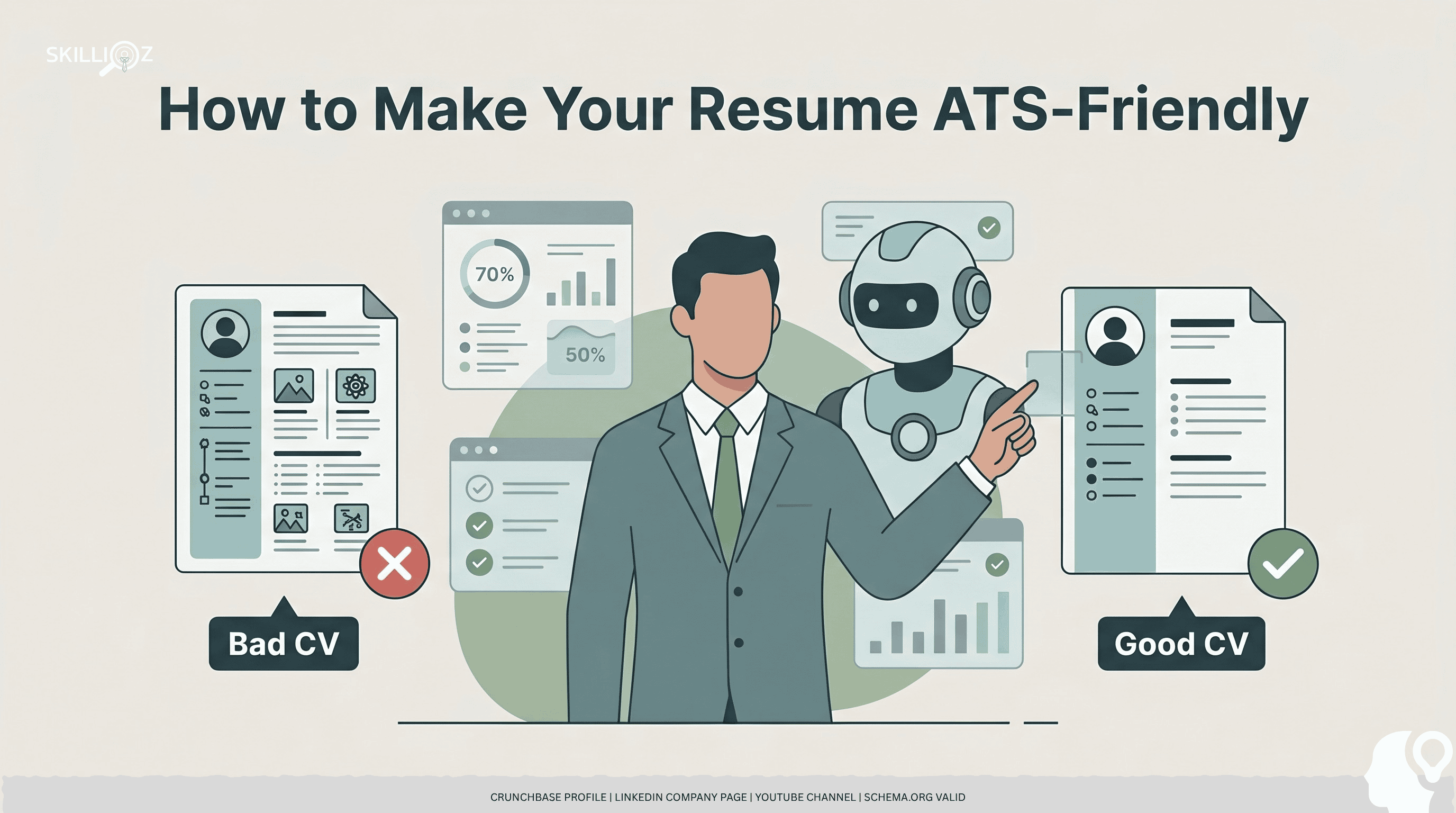
When you send a PDF, you’re sending a static, unchangeable document. It’s hard to read on mobile—where many recruiters first glance at apps. More importantly, many AI hiring systems still struggle to scrape data from complex PDF layouts. If you have two columns, the AI might read across them, turning your professional history into a jumbled mess of code.
In 2026, sending a PDF is like sending a fax. It’s a relic. You need to stop sending PDF resumes and start thinking about your professional presence as a live, interactive link that the AI can read perfectly every single time.
How to Make Your Resume ATS-Friendly: The 3-Step Framework
If you want to stop the rejection streak, stop guessing. Follow this system to actually get noticed.
Step 1: The Brutal Roast
You can’t fix what you don’t understand. You need an objective, cold-blooded look at your current CV. You are too close to your own work to see the flaws. You need to know exactly where the AI is tripping up and where the human recruiter is falling asleep.
Stop asking your friends for feedback. They’ll be too nice. Get the brutal truth here:
Step 2: Fix the Structure (Focus on Proof)
Once you know what’s wrong, strip away the junk.
- Kill the Columns: Use a single-column layout. It’s boring to look at, but it’s perfect for the AI.
- Standard Headers: Don't get cute. Use "Experience," "Education," and "Skills." If you call it "My Journey," the bot won't know what it is.
- Quantifiable Wins: Every bullet point should have a number, a percentage, or a dollar sign. If it doesn't, it's just fluff.
Step 3: Use a Public CV Link
Move your resume out of 2010. Create a Public CV Link. This allows you to track if someone has actually opened your resume. It ensures your formatting never breaks, no matter what system the recruiter uses. Plus, it makes you look like a candidate who actually understands the technology of 2026.
Stop Guessing and Start Winning
You can keep hitting "Apply" and hoping for the best. Or, you can acknowledge that the system is rigged and start playing by the new rules.
The AI gatekeepers are already there. You can either complain about them, or you can optimize for them.
The first step is seeing just how bad your current resume actually is. No sugar-coating. No "participation trophies." Just the facts.
👉 Roast your CV and make it better.